
GME Pathways Program
Tracks
- We have four medicine-specific tracks leading to internal medicine certification - a Categorical track, the Molecular Medicine Physician-Scientist Track and 2 Primary Care Tracks. Our Primary Care Tracks include UCSF Primary Care General Internal Medicine (UCPC-GIM) Track and ZSFG (SFPC) Primary Care Track.
- Learn more about the different tracks by using the navigation in the side bar.
GME Pathways Program
In addition to choosing a track to individualize your experience and gain exposure to a core group of faculty for mentorship, you may also enter an area of distinction through the GME Pathways program, which is open to all GME trainees, during the PGY2 and PGY3 years.
A few key points and frequent questions about the Pathways:
- PRIME and Molecular Medicine are only for categorical and physician-scientist track residents. All other Pathways are open to categorical and UCPC residents. All SFPC Residents are automatically enrolled in the Health Equities Track.
Descriptions of the Pathways
Global Health Pathway
The vision of the Global Health GME Pathway at UCSF is to engage trainees to become equitable, sustainable partners in global health clinical practice, as well as cultivate skills and knowledge relevant to decreasing health inequities and disparities locally and internationally.
For internal medicine residents, the pathway is a one-year curriculum involving dedicated cross-disciplinary education to teach fundamental topics such health and development, health metrics, ethics and human rights, communicable and parasitic diseases, non-communicable diseases and injuries, at-risk populations, global health players, and leadership skills utilizing a self-paced online course, intensive two-week core elective, and quarterly didactic sessions. The longitudinal curriculum consists of quarterly didactic sessions as well as connecting with mentors for project development and support. Global health residents are strongly encouraged to do a rural health longitudinal clinic and/or elective at our Clearlake or Eureka VA sites as PGY-2s and can do a one month away rotation as a PGY-3.
All residents interested in this pathway will be required to also apply to the University Wide GME Global Health Pathway program to participate in the required two-week core elective. Application deadlines are announced yearly and will be provided to all interested R1s. Thus, two applications must be submitted (one to Dr. Berman in the Internal Medicine Residency, and one to Dr. Cobb-Walch and Dr. McHale in the GME pathways program). Since the global health track is a one-year curriculum, residents can participate in the global health pathway in conjunction with a second pathway.
(VIDEO) Global Health Pathway Director Carmen Cobb-Walch
(VIDEO) Global Health Pathway Resident Max Pillsbury
Faculty Contacts:
Carmen Cobb-Walch, MD
[email protected]
Nicole McHale, MD
[email protected]
Clinical Informatics, Data Science and Artificial Intelligence Pathway
The Clinical Informatics, Data Science and Artificial Intelligence (CIDS-AI) Pathway is an introduction to the fields of Clinical Informatics, Data Science and Artificial Intelligence. It is intended as an opportunity for learners to learn basic concepts, principles, and skills in these fields, as well as act as a resource to help them consider and pursue careers in these areas.
The CIDS-AI Pathway consists of two components, a 1 week seminar around mid September, followed immediately by the start of the longitudinal pathway that goes through the end of the academic year. Learners can participate in only the 1 week seminar, or both the seminar and longitudinal pathway. Learners who want a deeper dive into these fields, and/or are considering a career in these areas should highly consider participating in both.
The 1 week seminar consists of lectures, workshops, panels, demos, and other activities. The goal is to provide a common foundation of knowledge and skills for all learners. There will be a focus on introducing workflows and resources available at UCSF that can be used to practice CI, DS, and/or AI, as well as how leverage those tools for different use cases (e.g. Information Commons, Versa AI, APeX tickets, etc).
The Longitudinal Pathway starts right after the seminar week and offers learners more hands-on opportunities to develop skills and learn more about Clinical Informatics, Data Science, and Artificial Intelligence. It consists of monthly meetings, regular updates about upcoming events in the field, and a “passport” of activities that learners can complete when able. Learners who complete the required passport activities, as well as enough optional ones, do get a certificate of completion for the pathway. Learners are encouraged to complete a scholarly project as part of the longitudinal pathway, and pathway leadership is available to help mentor learners as part of this.
This program is GME-wide and residents will interact with a variety of learners from different departments and levels of training, including Clinical Informatics Fellows.
CIDS-AI Related Links:
- CIDS-AI Website: https://meded.ucsf.edu/residents-clinical-fellows/gme-educational-professional-development-opportunities/gme-pathways/clinical-informatics-and-data-science-pathway
- Longitudinal pathway: https://ucsf.box.com/s/wld5i8wpxf4a8238rfc7m22wt0owymzp
Faculty Contact:
Xinran (Leo) Liu, MD, MS, FAMIA
[email protected]
Health Professions Education (HPE) Pathway
The HPE Pathway is designed for residents who are interested in making medical education a significant part of their future career. Trainees will participate in a comprehensive curriculum focused on direct teaching, curricular development, medical education research, learning theory, assessment and evaluation, education technology, and leadership. Participants will complete a mentored scholarly project and have the opportunity to meet and interact with prominent educator role models to learn more about a variety of career paths within medical education.
(VIDEO) HPE Pathway Resident Betty Kifle
(VIDEO) HPE Pathway Alum '22 Caroline Nguyen
(VIDEO) HPE Pathway Director David Chia
HPE Pathway Director: David Chia, MD
[email protected]
Co-Directors of HPE Pathway
- Naike Bochatay, PhD
[email protected]
Internal Medicine Longitudinal Pathway - Viridiana Garcia, MD
[email protected]
Health Systems and Leadership (HSL)
The curriculum consists of these core elements:
- A 2-year, longitudinal curriculum — including Friday morning half-day sessions while on elective/outpatient rotations and 1 week-long seminar covering the principles and practices of effective leadership, including identifying one’s core values, communication and relationship management, setting organizational direction, aligning and motivating others, negotiation, and business knowledge for the healthcare environment.
- A speaker series featuring invited guests ranging from recent graduates of our program to local health systems leaders, digital health entrepreneurs, and healthcare policy researchers. This series is designed to expose participants to a variety of career paths and perspectives, and provides an opportunity to learn from fellow physician leaders about what factors were important in choosing their first job, what their career path has looked like, and key learnings from navigating leadership challenges in their current roles. These speakers often go on to serve as mentors and advisors for HSL residents.
- Project-based experiences that give participants the opportunity to work with HSL leadership to identify a mentor and develop a project of personal interest. These projects may range from systems improvement efforts to healthcare policy work or traditional academic research, and often lead to journal publications, conference presentations, op-eds, or other meaningful capstone projects.
(VIDEO) HSL Pathway Alum '22 Esther Hsiang
(VIDEO) HSL Pathway Resident Laura Derry
(VIDEO) HSL Pathway Director Josué Zapata
Clinical Research Track - PRIME Program
The Clinical Research Track or PRIME Program, (also known as "Program in Residency Investigation Methods and Epidemiology" or "People Really Into Medical Epidemiology") is an area of distinction that focuses on outpatient clinical training, behavioral medicine, and clinical research skills. PRIME Residents may go into subspecialty or primary care fields. The Evidence Based Medicine (EBM) and clinical research training that make up a large part of the PRIME curriculum teaches residents the fundamentals of clinical evidence by giving them the skills in clinical research methods, mentoring, and protected time to complete a clinical research project during residency. EBM curriculum is taught through participation in the Resident Designing Clinical Research course as well as continuity sessions during other outpatient months.
Our goal is to give residents a chance to "try out" a career in clinical research during residency by completing an academic "PRIME project." These projects range from educational interventions (e.g. an examination of residents' screening habits for domestic violence) to secondary data analyses in outcomes research (e.g. evaluation of kidney disease as a predictor of revascularization outcomes) to meta-analysis (e.g., examination of the test-characteristics of alpha-feto protein levels in screening for hepatocellular carcinoma). Residents pursue topics that they feel passionate about and that can be utilized to become experts in their field. Approximately 66% of PRIME projects are accepted for publication.
(Video) PRIME Pathway Directors Beth Cohen & Evan Walker
(Video) PRIME Pathway Alum '21 Maria Duarte
Faculty Contacts:
- Jeffrey Kohlwes MD., MPH,
Co-Director, PRIME Program - Beth Cohen, MD., MA.
Co-Director, PRIME Program. - Evan Walker, MD.,
Co-Director, PRIME Program.
Health Equities and Advocacy Track HEAAT
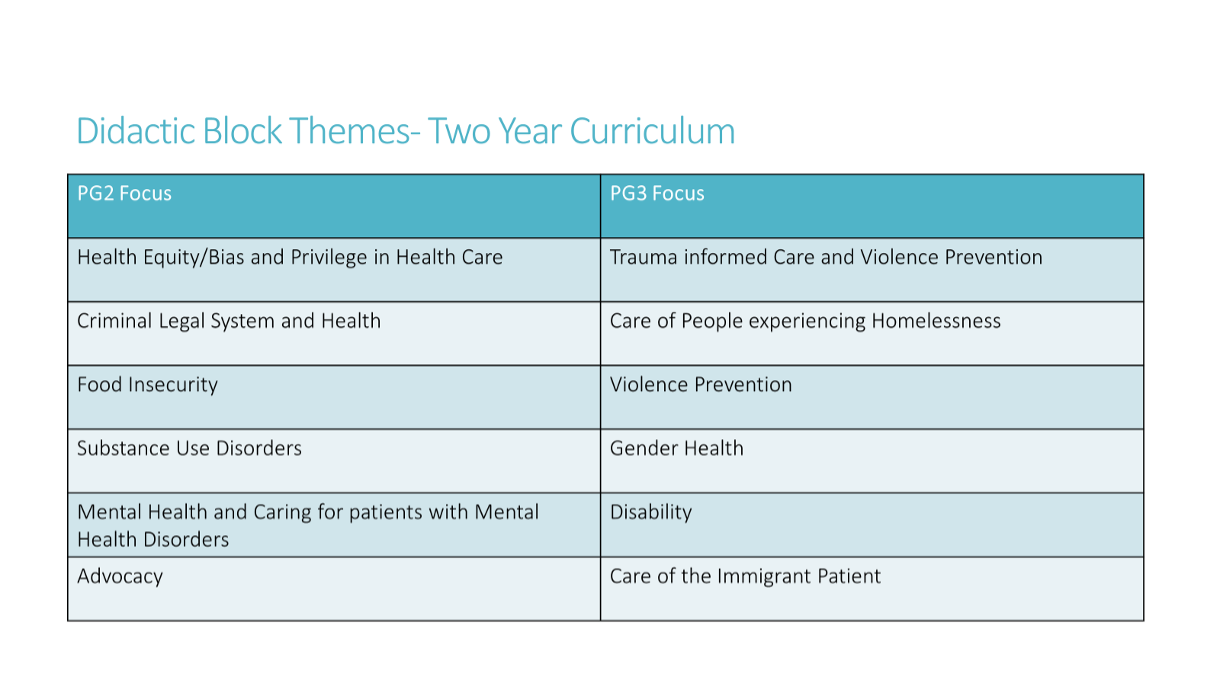
The Health Equities and Advocacy Track is centered at Zuckerberg San Francisco General Hospital. All SFPC residents are a part of this track, but our HEAAT curriculum, which occurs every Friday morning during block, is offered to all second and third-year internal medicine residents within UCSF. This is a two-year curriculum focused on understanding healthcare disparities at both individual patient and population levels, as well as solutions which critically examine and address the inequities in U.S. health care at large. Through a series of seminars, lectures, field trips and case conferences, residents explore the ways that social factors influence illness and the practice of medicine. They gain an in-depth knowledge of the issues surrounding disparities in health and health care by concentrating on vulnerable patient populations. The one-month block themes for the 2-year curriculum are listed below and updated each year based on feedback from residents.
(Video) Health Equity Director Joanie Addington-White
(Video) Health Equity Pathway Alum '21 Ilana Garcia-Grossman
(Video) Health Equity Alumni '22 Irving Ling
Track contact is Joan Addington-White, MD at [email protected].
Physician-Scientist Training Program
(Video) PSTP Pathway Director Neil Shah